
Own a holiday home in Zermatt?
Luxury chalet management in Zermatt
Marketing, guests, teams, official obligations: what a premium management service looks like in a car-free village where everything arrives by rail.
Local team on the ground in Zermatt · Response within 24 hours
 ★ 4.9/5 on Airbnb
 01A complete service, in four responsibilities
Behind the word "premium" sit four responsibilities that someone has to carry: filling the calendar at the best achievable rate, keeping the property fit to receive guests, looking after those guests before, during and after their visit, and answering for the legal obligations that come with letting. Chalet management in Zermatt means holding all four in one pair of hands, with someone who is accountable rather than four suppliers pointing at each other.
The gap between that and a piecemeal arrangement shows the moment something goes wrong. A cleaning firm cancels on Saturday morning, a guest reports a leak on Sunday, a platform holds back a payout: in a fragmented set-up all of it lands on the owner, who finds out from a desk hundreds of kilometres away. In an integrated one, it is absorbed before they ever hear about it.
Zermatt adds a constraint no other Valais resort imposes to the same degree: the village is closed to cars. You get there by train from Täsch, and the entire mechanics of the service follow from that. It is not picturesque detail for a tourist brochure; it is the variable that shapes schedules, costs and the promises anyone can reasonably make to a guest.
02Receiving guests who arrive by rail
Entry to the property can be entirely self-service, at any hour, and we are glad to add someone on site at the moment of arrival where the property or the clientele calls for it. The two complement one another: the first guarantees that no guest is ever left outside, the second brings the human element expected by people used to hotels. The practical side of that arrangement is covered on our page about remote check-in in Zermatt.
Train times and connections from Geneva, Zurich or Milan spread arrivals right through the evening, often with heavy luggage and mountain equipment in tow. Nobody can tell a tired guest to wait until the morning to find out how the property works: what needs explaining is either said that same evening, or readable in thirty seconds from a document prepared in advance.
The walk-through, meanwhile, remains irreplaceable in a high-end property: heating settings, the particulars of the sauna or hot tub where there is one, where skis and boots belong, how waste is sorted in this commune, the number to call if anything goes wrong. Across a week's stay, those few minutes save a string of messages and, more to the point, a few expensive mistakes.
03Getting teams and linen up the valley without a van
This is the most tangible peculiarity of Zermatt. A significant share of the housekeeping staff lives down the valley, in Täsch or Randa, for want of accessible housing in the village, and comes up by train for every job. Rotas are therefore written to the railway timetable, and the number of properties a team can turn around on a Saturday in high season has a structural ceiling. Our page on housekeeping in Zermatt sets out that constraint and how we work around it.
The same logic governs hotel-quality linen. Sheets and towels go to the laundry and come back clean before the next arrival: every rotation means organised transport, a reserve placed in the property ahead of time and a buffer stock to absorb the busy weeks. Cleaning products, consumables and spare parts travel the same way, on foot or in the electric vehicles permitted in the village.
Maintenance, for its part, relies on trades based in Zermatt itself - heating engineer, electrician, plumber, spa technician - whose diaries fill early and whose availability is a scarce resource at the height of the season. We inspect the property before each arrival rather than after each departure: that is the only moment at which a fault can still be put right before somebody finds it.
04Guests from everywhere, two seasons a year
Few alpine villages host a clientele as varied. Zermatt draws travellers from across Europe and far beyond, many of whom book a long way ahead and ask detailed questions before confirming. Our replies go out in English, French and German, written rather than run through a translation tool, and fast enough to matter when the same guest is comparing several properties at once.
The annual rhythm differs from that of a purely winter resort. The Matterhorn brings visitors twelve months a year, summer skiing on the glacier extends the sporting season, and the Gornergrat attracts walkers and sightseers well into autumn. The same apartment therefore hosts skiers laden with equipment and hikers who left at five in the morning: the equipment, the house notes and the service hours cannot stay identical.
During the stay, assistance is a matter of very ordinary things: a restaurant booking, a guide for a climb, a question about the lifts, a last-minute extension. Settled within the hour, these turn into glowing reviews; left unanswered, they leave a feeling of neglect that later shows up in the property's ranking.
05Bringing the property to market at the right price
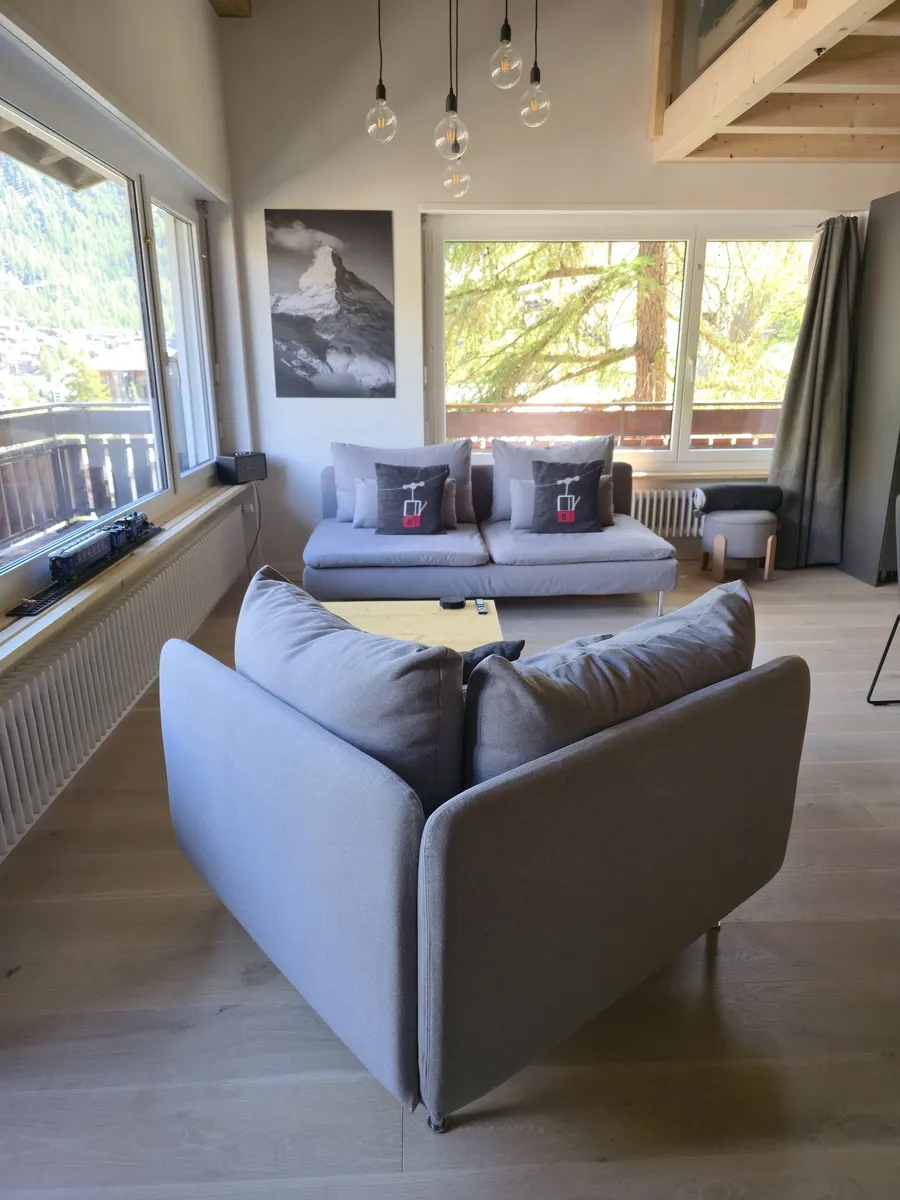
It all starts with a professional photo shoot. In a village where a view of the Matterhorn is a selling point in itself, the quality of the images and the order they appear in weigh heavily on the click-through rate, and therefore on the number of nights sold.
Listings are then written language by language and published simultaneously on Airbnb, Booking.com and VRBO, with synchronised calendars that rule out any double booking. Every platform brings a distinct profile of traveller, and a property that exists on only one channel forfeits part of the summer demand as well as the long winter reservations.
Finally, rates move continuously according to the period, the occupancy already achieved and how much time is left before the date. Festive weeks, the February school holidays, the spring bridges and the heart of summer differ in both value and elasticity, and an unsold night is never recovered. That is what active property management is for: adjusting before the window closes rather than noting afterwards that it has.
06Official obligations, met without troubling you
Every night sold generates formalities. We declare the overnight stays, collect and pay over the tourist tax in Zermatt and keep the guest register up to date, including the identification required for every stay. Taken one at a time these steps are simple; accumulated across a full season and handled from abroad, they become unmanageable.
The rest of the framework - the property's Lex Weber status, Valais registration, insurance suited to a letting activity - is presented on our page about the regulations in Zermatt. We would rather check those points before the first booking than after an inspection.
Each month you receive a statement: nights sold, channels they came from, sums collected, deductions, technical work carried out. You get a consolidated view of how your property is trading, exactly as if you were keeping the books yourself - except that you are not spending your time on it.
07Paid on results, with an owner who stays at home
We charge 25% of the net amount - after platform fees, transaction fees and cleaning, the latter rebilled to the guest. No monthly retainer, no minimum term: a quiet season costs you nothing in fees. That structure obliges the manager to care about occupancy as much as the owner does, which a fixed subscription never guarantees.
Most of our clients live a long way from Valais and do not travel up: they do not take the train from Täsch to meet a plumber, hand over no keys and organise no changeovers. They receive what they need to decide and rule on what is theirs to rule on - weeks reserved for their own use, investment in the property, pricing strategy. Delivery is our job, through our full rental management.
Before you commit, we assess your property free of charge: where it sits in the village, the revenue within reach, the improvements worth considering, the launch schedule. You receive an answer within 24 hours and then decide freely. Our luxury chalet concierge services in Zermatt are set out in full on the main Zermatt page.
Hand your property to a team that knows the village
We assess your apartment or chalet in Zermatt free of charge: achievable revenue, how the service will be organised and when to go live. Answer within 24 hours.
Request my free auditFrequently asked questions
What does high-end chalet management change for an owner in Zermatt?
It brings four things under one roof: putting the property on the market (professional photography, listings in several languages, publication on Airbnb, Booking.com and VRBO, rates matched to the village calendar), receiving and assisting guests, organising housekeeping teams and linen, maintenance through trades based in the village, plus the official side - overnight stays declared, tourist tax collected and paid over, guest register maintained, and a monthly statement sent to the owner.
Why does a car-free village make managing a property harder?
Because every person and every item entering Zermatt arrives by train from Täsch and then moves on foot or by electric vehicle. A large part of the housekeeping workforce lives down the valley, in Täsch or Randa, and travels up by rail: timetables become a scheduling constraint, the number of changeovers achievable on a Saturday in high season has a ceiling, and clean linen and supplies have to reach the property without a van. A manager who ignores that chain promises times it cannot keep.
Does the summer and winter double season change how a property is managed?
Considerably. The Matterhorn, summer skiing on the glacier and the Gornergrat bring guests all year round, with different expectations: families and skiers in winter, hikers and mountaineers in summer, often for shorter stays. The pricing calendar, the minimum stays and the rhythm of changeovers are therefore built around two seasons rather than one winter followed by eight quiet months.
What does your rental management in Zermatt cost?
We take 25% of the net amount - that is, after platform fees, transaction fees and cleaning, the latter being rebilled to the guest. No subscription and no minimum term: what we earn depends entirely on what your property generates. The initial assessment costs nothing and you get an answer in under 24 hours.
Further reading
Zermatt concierge service
Everything we handle for owners in the village.
Housekeeping in Zermatt
Scarce teams, staff arriving by train and hotel linen.
Remote check-in
Arrival via Täsch, luggage and key handover.
Rental management
The offer, what it includes and how it is remunerated.
Free audit
A reasoned estimate for your property, within 24 hours.