
Own a holiday home in Gstaad-Rougemont?
Remote check-in in Gstaad-Rougemont: key handover and guest welcome
Arrivals by MOB train or by road, chalets off the beaten track, a demanding international clientele, two working languages: organising flawless arrivals without being there.
Local team on site in Gstaad-Rougemont · Response within 24 hours
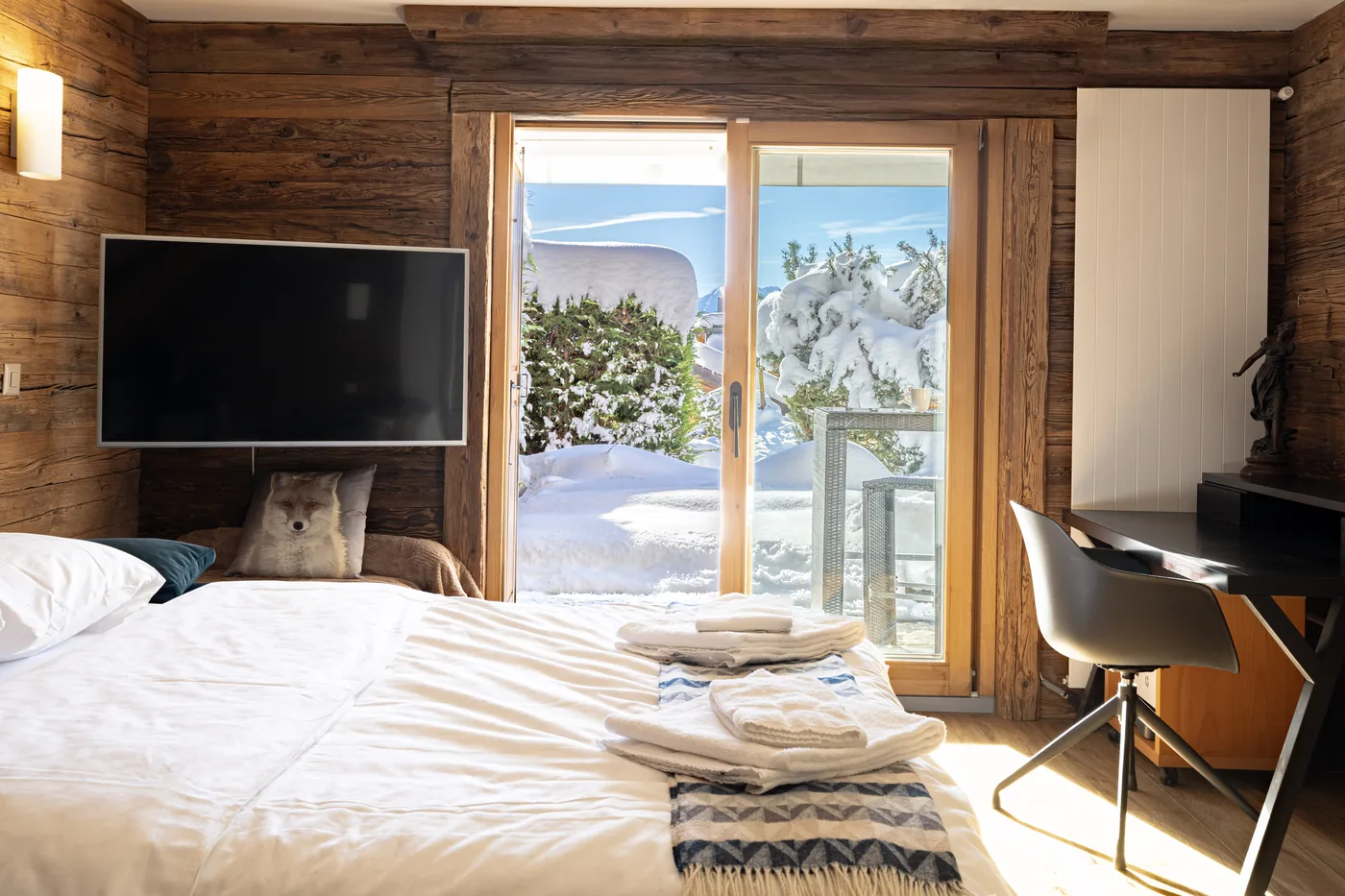
01An easy valley to reach - but unpredictable arrivals
The Saanenland is not a difficult valley. The road stays open all year, both from the Vaud Riviera via the Pays-d'Enhaut and from the Simmental on the Bern side, and the MOB train serves the villages directly, from Rougemont to Zweisimmen via Saanen, Gstaad, Schönried and Saanenmöser. There is no car-free village, no compulsory last shuttle, no luggage to be hauled up by cable car.
The problem is therefore not accessibility: it is unpredictable timing, which is particularly pronounced here. The clientele is largely international and arrives by air, with transfers from Geneva or Zurich subject to the vagaries of flights and weather. Others drive up after a working day, or push their arrival back an hour without warning because they stopped along the way. In-person check-in at a fixed time is unmanageable in those conditions, and merely shifts the stress onto the guest. A rigorously prepared remote check-in, by contrast, absorbs all of it without anyone having to worry.
02Finding the right door: villages that are close and easy to confuse
The real difficulty lies elsewhere: the destination is spread across several distinct villages, all a few minutes apart, whose names look alike to a foreign visitor. Gstaad and its Promenade, Saanen the main town, Schönried and Saanenmöser higher up, Rougemont on the other side of the cantonal border. A guest who simply types "Gstaad" into the sat-nav when their chalet is in Rougemont or Saanenmöser loses twenty minutes and starts the stay on the wrong foot.
Chalets add another layer of complexity: access via a private lane, a gate to open, an unnumbered parking space under a canopy, an entrance at the rear of the building, neighbouring houses with no street number legible under the snow. Our access instructions are therefore built around a precise GPS point, photographs of the façade, the gate, the parking space and the front door, and a step-by-step route from the last known landmark. All of it is sent before departure, not on arrival: mobile coverage is not uniform on mountain roads, and a guest who has to download a document at the end of a snowy lane at 10 p.m. is already an unhappy guest.
03Arriving by train: the MOB, and the last few metres
A significant share of guests arrive without a car, and it is a trend to encourage rather than endure: the guest card issued from the first night includes regional public transport, which makes a car-free stay perfectly comfortable. We set this out on our page on the tourist tax in Gstaad-Rougemont, since it is precisely what that tax buys.
But arriving by train changes the instructions completely. A guest stepping off at the station with suitcases, skis and children does not experience the same last kilometre as a driver: a ten-minute uphill walk with luggage, in the snow, is no small thing, and "the property is 900 metres from the station" says nothing about the gradient. Our instructions therefore always contain two scenarios, "by car" and "by train", the latter specifying the exact stop to aim for, the real distance, the slope, and the alternative in case of heavy luggage or bad weather.
04Key box, smart lock or in-person welcome?
All three coexist, and the right choice depends on the property. For a detached chalet, the smart lock is hard to beat: a unique code per stay, automatically revoked on departure, no physical key to lose in the snow, and a record of entries - something that reassures non-resident owners considerably. For an apartment in a condominium, the question gets more complicated: main door, garage access, ski room, and sometimes rules governing installations on common parts. A secure key box, correctly placed, discreet and documented, then often remains the most robust solution.
In every case the rule is the same: a single device should open everything the guest needs. Nothing is more discouraging, at 10 p.m. and −10 °C, than a code for the building, a key for the door, a fob for the garage and another key for the ski room. We systematically rationalise access before the first letting. And we keep the in-person welcome where it genuinely adds something: a first stay in a complex chalet, handing over equipment, or guests who expect human contact on arrival.
05Two languages, an international clientele: the welcome must keep up
This is a feature of the destination that is easily underestimated. On the Saanen side, the environment is German-speaking; in Rougemont, it is French-speaking. Your guests, meanwhile, are frequently English-speaking, Italian-speaking or from elsewhere entirely. Access instructions, recycling rules, heating guidance, emergency numbers and local recommendations must therefore be available in several languages, and above all be correct: a roughly translated German notice creates more confusion than it resolves.
The same reasoning applies to the support line during the stay. A guest calling at 9 p.m. because the underfloor heating will not come up must reach someone who understands them and who can then, straight away, speak to the local technician in his own language. That is exactly the role played by a team based on the ground and used to working on both sides of the valley.
06The 27 December, 10 p.m. scenario
27 December, 10.10 p.m. A family arrives two hours late, it is snowing, the driver cannot find the access lane, and the key box code fails on the first attempt because fingers are frozen and the keypad is poorly lit. An owner managing remotely from London or Milan finds the message the next morning. That is precisely the moment when a property's reputation is decided, and when it is settled whether that family will come back next year.
Our set-up rests on three levels: instructions sent in advance, tested on the ground, with photographs and a route; support that is reachable during arrival windows; and a local team able to come out. On this last point, the valley offers a real advantage: with the road passable all year and the villages close to one another, an evening call-out remains possible, which is not the case everywhere in the Alps. The guest, for their part, remembers only one thing: everything worked.
07A successful check-in starts with a property that is ready
The best access system in the world will not save an arrival at a badly prepared chalet. A code that works, but an un-cleared terrace, heating that was not switched on the day before, a cold wellness area or incomplete linen produce exactly the same negative review as a key that cannot be found. We therefore treat access and preparation as one and the same process, described on our page on cleaning in Gstaad-Rougemont, within our full rental management service.
Arrival is also the moment when guests receive their practical information and their guest card - the Gstaad Card on the Bern side, the Pass d'Enhaut on the Vaud side. It is a small gesture, but it turns a tax into a perceived benefit and opens the stay on a good impression. Finally, for owners whose property falls in the canton of Vaud, remember that notifying the municipality and keeping a guest register are legal obligations: we set them out on our page on regulations in Gstaad-Rougemont.
Flawless arrivals, without being there
Our free audit assesses the potential of your property in Gstaad-Rougemont and the access set-up best suited to it. Answer within 24 hours.
Request my free auditFrequently asked questions
Can guests come to Gstaad or Rougemont without a car?
Yes, and it is worth highlighting in your listing. The MOB line serves Rougemont, Saanen, Gstaad, Schönried, Saanenmöser and Zweisimmen, with connections from Montreux on one side and from the Bernese Oberland on the other. The guest card handed to your travellers also includes regional public transport. Access instructions must therefore always cover two scenarios: arriving by car and arriving by train.
Key box or smart lock in a Saanenland chalet?
It depends on the property and on the condominium rules. For a detached chalet, a smart lock is hard to beat: a unique code per stay, revoked immediately on departure, no key to lose in the snow, and a record of entries. In an apartment building you have to deal with the main door, the garage and the ski room, and a well-placed secure key box often remains more robust. We decide property by property, taking into account mobile coverage and the owner's need for discretion.
How do you handle late arrivals, especially over the holidays?
The guest receives access instructions in advance, with photographs, a precise GPS point and a step-by-step route, and can get in at any hour. A support line stays reachable during arrival windows and our team is on site, with the valley accessible by road all year round. This is the most frequent scenario here: delayed flights, transfers from Geneva or Zurich, families driving up after a working day.
Is remote check-in compatible with a high-end clientele?
Yes, provided it is impeccably prepared - and many guests actually prefer it. Self-access that works first time, at the hour that suits them, is more comfortable than a fixed appointment negotiated from the motorway, and it respects their privacy. We stay reachable, we come out when the situation calls for it, and we keep in-person welcome where it genuinely adds something: a first stay in a complex chalet, handing over equipment, or guests who expect it.
Further reading
Gstaad-Rougemont concierge service
Premium rental management for your chalet in the Saanenland.
Cleaning in Gstaad-Rougemont
Hotel standards, aged timber, wellness areas and linen.
Tourist tax in Gstaad-Rougemont
Gstaad Card, Pass d'Enhaut and declaring overnight stays.
Rental management
Welcome, cleaning, maintenance and compliance in a single offer.
Letting your second home
The concrete steps, from going live to the first arrival.