
Own a holiday home in Veysonnaz?
Buying an apartment or chalet in Veysonnaz to let it
Competent municipality, Lex Weber, a flat-rate tax calculated on the number of rooms, mayens and Lex Koller: what to check before making an offer on the Sion-side gateway to the 4 Vallées.
Local team on the ground in Veysonnaz · Response within 24 hours
01Buying into the same ski area, at a different price
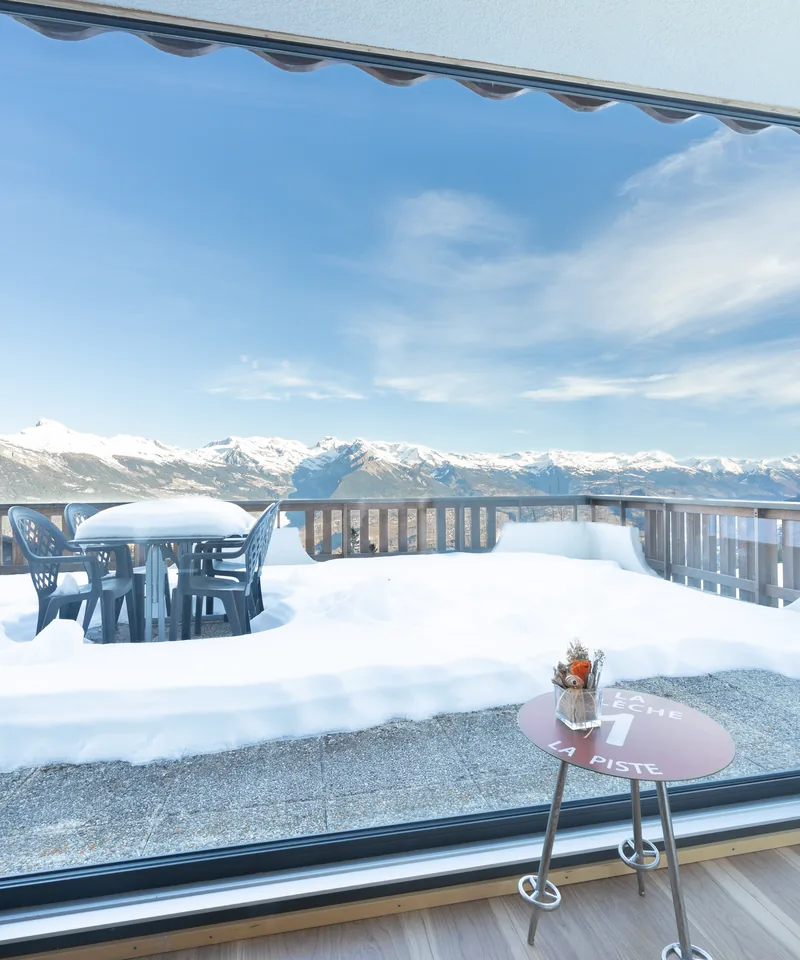
The investment case for Veysonnaz fits into one sentence, and it is a solid one: you gain access to the same ski area as Verbier, on a property market that does not carry the same prices. The 4 Vallées form one of the largest ski areas in Switzerland, and Veysonnaz is one of its gateways, on the terrace above the Rhône valley. For a buyer, the valuation gap between the two sides of the ski area is the starting point of the reasoning.
But an investor who stops at that arbitrage misses what really makes the resort work. Veysonnaz is not a budget version of Verbier: it is a village on a human scale with a clientele of its own, largely made up of regulars who come back every year. That profile produces steady, predictable occupancy, little dependent on marketing campaigns - but it also imposes a requirement of consistency: in a market of this size, reviews and word of mouth carry more weight than anywhere else. A poorly kept property cannot be rescued by sheer volume of traffic.
The second structural element, often undervalued, is the proximity of Sion and the motorway, about fifteen minutes away. It mechanically widens the pool of potential guests - short midweek stays, weekends decided the day before, late arrivals after a flight - and it reduces the operating cost of management, since linen, consumables and extra staff can come up from the valley within the day. That is a real advantage over resorts at the head of a valley, and it translates into occupancy as much as into margin.
02The check nobody makes: which municipality are you buying in?
This is the first point of due diligence in Veysonnaz, and it has no equivalent in the neighbouring resorts. The Veysonnaz tourism area (giron touristique) extends across three municipalities: Veysonnaz, Nendaz and Sion (formerly Salins). A property presented by an agency as being "in Veysonnaz", because it stands a few minutes from the gondola, may cadastrally lie on Nendaz or Sion territory.
The consequences are directly financial. The Veysonnaz regulation sets an annual flat-rate tourist tax calculated on the number of rooms; the Nendaz regulation rests on a tourist zoning and on gross floor area. The per-night rates, the declaration deadlines and the counterpart all differ. Two comparable apartments either side of a municipal boundary therefore have neither the same annual charge nor the same obligations - a gap that repeats itself every year you hold the property.
The question arises before the offer, on the basis of the cadastral extract, and not after signing. If the property you are looking at comes under Nendaz territory, it is our guide to buying to let in Nendaz that describes the applicable framework, with its own zoning logic. This verification is part of our purchase support.
03The number of rooms: an underestimated purchase criterion
Here is a parameter specific to Veysonnaz that almost every buyer overlooks, and that weighs on the operating account every year you hold the property. The municipal regulation calculates the annual flat-rate tourist tax on the number of rooms - and not on floor area, unlike other Valais municipalities. The mechanism is transparent: an average occupancy set at 45 nights, multiplied by the amount of CHF 4.– applicable to holiday accommodation, giving CHF 180.– per household unit (UPM).
The number of UPM follows the number of rooms as recorded in the Federal Register of Buildings and Dwellings: 2 UPM for a studio (CHF 360.–), 2.5 for a 2-room home (CHF 450.–), 3 for a 3-room home (CHF 540.–), 5 for a 4-room home (CHF 900.–), 5.5 for a 5-room home (CHF 990.–) and 7.5 for a home of 6 rooms or more (CHF 1,350.–).
Two lessons for a buyer. First, the step between the 3-room and the 4-room home is disproportionate: you go from 3 to 5 UPM, and therefore from CHF 540.– to CHF 900.– a year, for a difference in floor area that is sometimes small. Second, it is the register that counts, not the agency's listing nor the number of beds. A property sold as a "large 3-room apartment" but registered as a 4-room home will be taxed as a 4-room home. Checking that figure during the negotiation phase costs a phone call; discovering it on the first annual invoice costs more. The full detail of the mechanism is set out in our guide to the tourist tax in Veysonnaz.
04Lex Weber at purchase: designated use, not prohibition
Since 2013 the Lex Weber has frozen the construction of new "classic" second homes in municipalities exceeding the 20% threshold - which is the case in Veysonnaz. It does not prohibit letting, but it creates two categories of property that a buyer must be able to tell apart before making an offer.
Properties built or authorised before the freeze benefit from acquired rights: they can be bought, used, resold and let freely, including short-term. Some more recent properties were authorised, by contrast, on condition of being designated for tourist accommodation, which requires them to be placed durably on the rental market, sometimes under specified operating arrangements. For a buyer intending to occupy the property for several weeks a year, the difference is decisive - and it is read at the land register, not in the listing.
Note the market effect: because new supply is frozen and the resort is small, the existing stock is structurally limited. That supports the value of properties, but it also reduces liquidity on resale: there are fewer transactions than in Verbier or Crans-Montana, and an atypical property may take time to find a buyer. This parameter has to enter into any holding plan, especially if the horizon is short. The whole framework is set out in our guide to the regulations governing short-term rentals in Veysonnaz.
05Where to buy: resort centre, Magrappé, old village or mayens
The resort centre, around the gondola, is the most liquid sector and the simplest to operate. A property that can be advertised as ski-in/ski-out captures the number-one argument for families, and the density of the sector allows efficient changeovers. It is the default choice for an investor seeking consistency rather than maximum yield.
Magrappé, the residential sector between the village and the resort, offers the best compromise between entry price and rental potential, with buildings that often have parking and quick access to the lifts. It is the natural ground for a first investment. The counterpart: these are co-ownerships (condominiums), so there are co-ownership rules to read and service charges to anticipate.
The upper village - historic Veysonnaz, its chalets and its raccards - attracts a different clientele: couples, families in summer, guests who respond to character. Properties with old timber and a panoramic balcony stand out clearly on the platforms, but access is more constrained and parking scarce, which complicates management. Finally, the mayens and isolated chalets form a premium niche market, one to enter with your eyes open.
The right choice depends not on the prestige of the sector but on the fit between the type of property, the clientele targeted and your own use of it. An investor who will never occupy the property and an owner who wants to spend February there should not buy in the same place, nor the same kind of home - and, in Veysonnaz, not under the same tax regime either.
06The particular case of the mayen: niche returns, real constraints
The renovated mayen - a traditional Valais alpine barn converted into accommodation - is the most distinctive asset in Veysonnaz. On the platforms it does not compete in the same category as a resort apartment: it sells an experience, old timber, a fireplace, a view, a story. That allows it to be positioned clearly above a comparable apartment, on shorter but better-valued stays, and to capture demand from couples and lovers of heritage that the resort does not otherwise attract.
The constraints match the asset. Some mayens lie outside the building zone or carry restrictions inherited from their original agricultural use, which limit the scope for conversion and sometimes the rental use itself. Others fall under building conservation requirements bearing on volumes, materials or openings - the municipality is carrying out an inventory of the built heritage. To this are added operational realities: winter access to be checked, the upkeep of an old building, insulation and heating, heavier cleaning logistics, and mobile coverage that is sometimes patchy.
None of these constraints is a deal-breaker, but all of them must be documented before the offer, with the municipal technical department and on the basis of the land register. A mayen bought without that verification may prove impossible to operate the way the buyer imagined - or may require works whose budget completely changes the return.
07What really drives rental income in Veysonnaz
The first driver is access to the 4 Vallées, and it belongs in the listing title. The second, more discreet but decisive, is guest loyalty: a significant share of occupancy is built on guests who come back, often booking direct. A property that satisfies fills up year after year with less and less commercial effort; a property that disappoints starts from scratch every season. This is why the quality of management weighs more heavily in Veysonnaz than in a resort driven by passing trade.
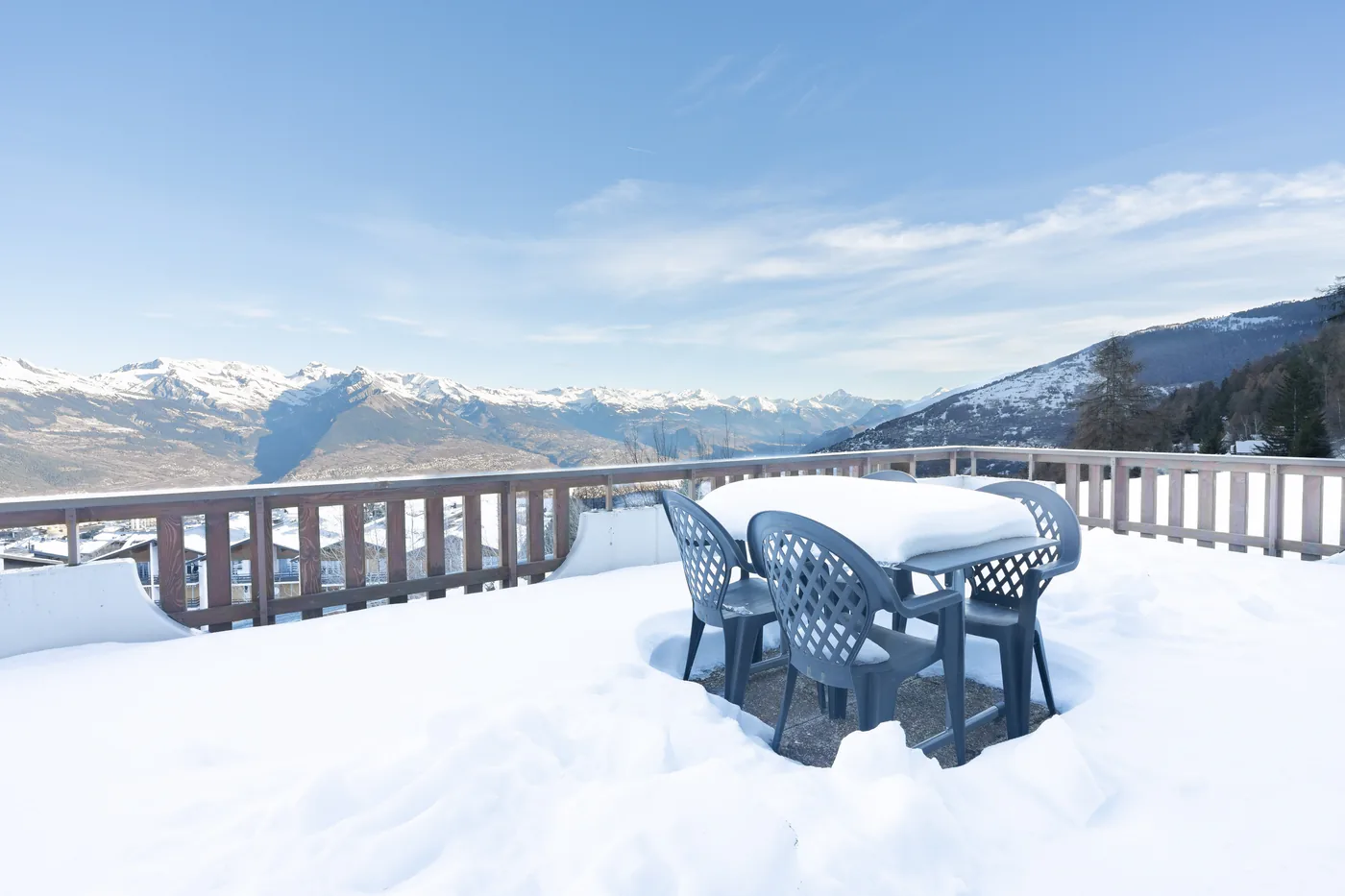
The third driver is the view and the sunshine. The terrace above the Rhône valley is a genuine conversion argument on the platforms: at comparable size and location, a property with an open view and a well-exposed balcony lets better and reviews better. Then comes the resort's sporting identity - the piste de l'Ours and its international races - which brings recognition and a few very dense weekends, but which does not fill a season on its own: it should be treated as an accelerator of visibility, not as a revenue model.
Finally, summer deserves to enter the calculation from the moment of purchase. Hiking, the bisses, mountain biking and e-biking, trail running, paragliding: summer demand is real, carried by shorter stays and supplemented by a local clientele that the presence of Sion fifteen minutes away makes accessible. A property designed for winter alone leaves that share of the potential untapped.
08Buying as a non-resident: Lex Koller and co-ownership
If you are not domiciled in Switzerland, the Lex Koller governs the acquisition of real estate by persons abroad: depending on your status and the property concerned, an authorisation may be required, cantonal quotas apply, and restrictions on floor area or resale may exist. This is a check to carry out very early on, with a notary, because it determines the very feasibility of the project - and sometimes the obligation to place the property on the rental market.
The second check, unavoidable for the stock in Magrappé and the resort centre: the co-ownership rules. Some of them regulate or restrict short-term letting, the installation of access devices on common parts, the use of the ski room or the allocation of parking spaces - all points that then determine your ability to operate the property independently. To this is added the question of service charges and works: in a resort where part of the stock was built over successive decades, renovations to the building envelope, the heating or the lifts are decided in general meeting and passed on to the co-owners. Reading the minutes of the last general meetings costs an evening; discovering them after the purchase can cost a season of income.
09From viewing to first booking: how we support you
We step in at two points. Before the purchase, we analyse the property from the point of view of rental returns: the competent municipality within the tourism area, Lex Weber status, the number of rooms in the register and the corresponding flat-rate tax, co-ownership or building constraints, the fit between the layout and the family clientele of regulars, and the potential in summer as well as winter. That is the purpose of our purchase support, which spares you discovering after signing that a property cannot be operated the way you imagined.
After the purchase, we take the property under management: compliance and notification to the municipality, furnishing and equipment suited to the market, professional photography showcasing the view and the aspect, creation and distribution of listings with access to the 4 Vallées front and centre, dynamic pricing aligned with the school holidays and the race weekends, guest welcome, cleaning and maintenance, and specific work on guest loyalty - the most powerful yield lever in this resort. Our commission is 25% of the net amount collected after deduction of platform fees, transaction fees and cleaning, the latter being charged to the guest. All of it is described on the page of our concierge service in Veysonnaz, within our all-inclusive rental management.
Planning a purchase in Veysonnaz?
Before making an offer, validate the rental potential, the competent municipality and the regulatory status of the property. Our free audit gives you the answers within 24 hours.
Request my free auditFrequently asked questions
Does the Lex Weber prevent buying to let in Veysonnaz?
No. Veysonnaz far exceeds the 20% second-home threshold: the construction of new "classic" second homes has been frozen there since 2013. But existing properties benefiting from acquired rights can be bought and let freely, including short-term. Some more recent properties, by contrast, carry a tourist-accommodation designation that requires them to be let. This status is verified at the land register before signing.
Does the number of rooms have a financial impact when buying in Veysonnaz?
Yes, and it is a local particularity. The annual flat-rate tourist tax of the municipality of Veysonnaz is calculated on the number of rooms as recorded in the Federal Register of Buildings and Dwellings, at CHF 180.– per household unit. Moving from a 3-room to a 4-room home takes the property from 3 to 5 units, that is from CHF 540.– to CHF 900.– a year, for a difference in floor area that is sometimes modest. The question arises before the offer.
Should you be wary of a mayen to renovate in Veysonnaz?
You should above all analyse it for what it is: a niche rental asset, with strong differentiating power but high constraints. Some mayens lie outside the building zone, carry restrictions inherited from their agricultural use or fall under building conservation requirements. Add to that winter access, maintenance costs and heavier management logistics. These points are checked with the municipal technical department before the purchase, not after.
What type of property lets best in Veysonnaz?
Properties that combine three elements: genuine family capacity, easy access to the lifts and an open view over the Rhône valley. The resort lives off a clientele of regulars who come back every year for the ski-in/ski-out access and the view of the Bernese Alps. What makes the difference is not luxury but functionality and ease of use, with proper storage for sports equipment.
Further reading
Veysonnaz concierge service
Complete rental management of your property on the balcony of the 4 Vallées.
Regulations in Veysonnaz
Tourism area, notification to the municipality, Lex Weber and mayens.
Purchase support
Analysis of a property's rental potential before you make an offer.
Tourist tax in Veysonnaz
CHF 4.– per overnight stay and an annual flat rate calculated on the number of rooms.
Buying a second home to let it
The complete guide to rental investment in a ski resort.