
Own a holiday home in Veysonnaz?
Tourist tax in Veysonnaz: the owner's guide
Rates by category of accommodation, an annual flat rate calculated on the number of rooms, a tourism area straddling three municipalities and seasonal declarations: everything a landlord owner needs to know about the Veysonnaz regulation.
Local team on the ground in Veysonnaz · Response within 24 hours
01First question in Veysonnaz: which municipality is your property in?
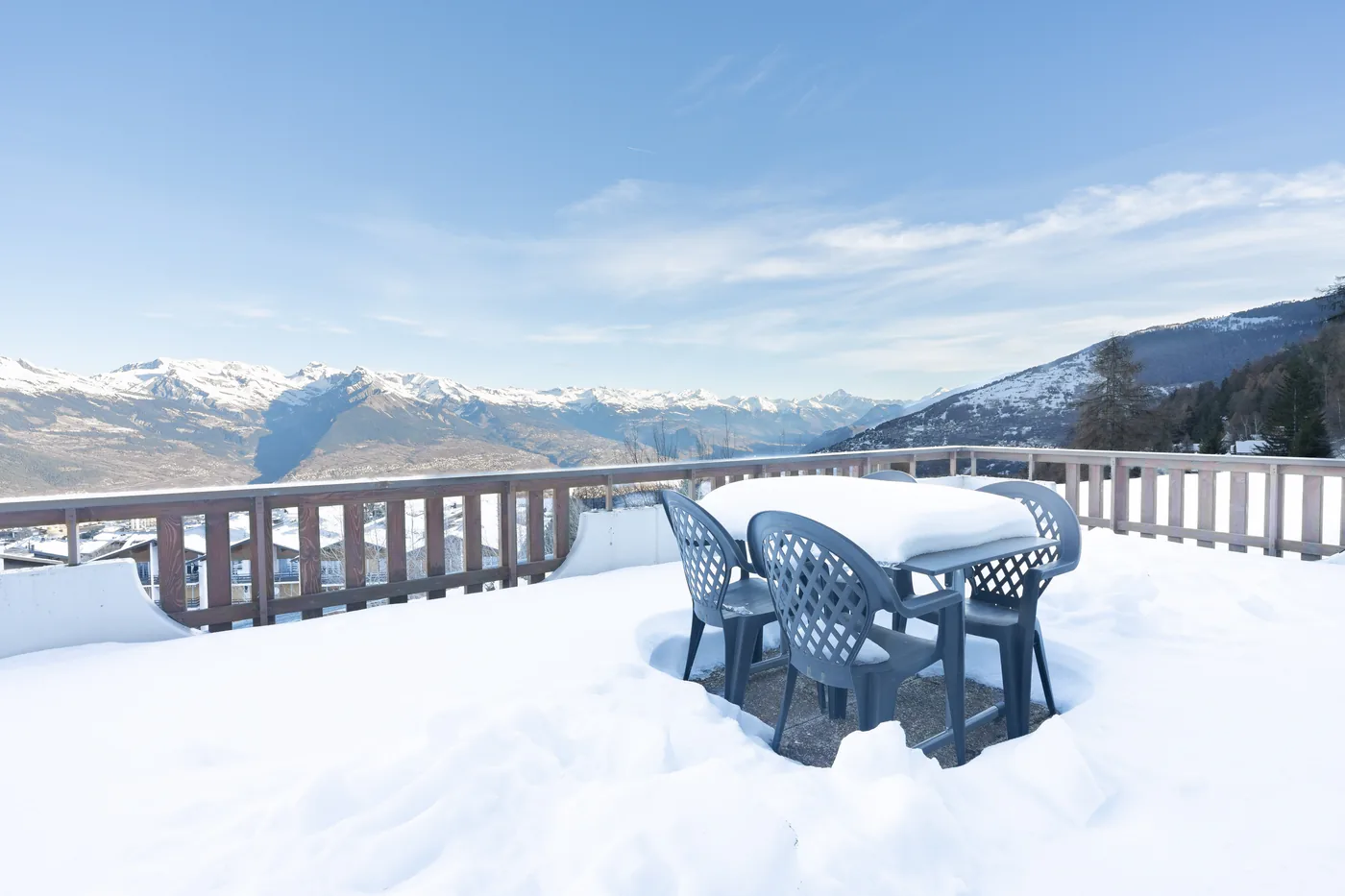
This is the particularity that confuses almost every owner, and it exists nowhere else in this form in the 4 Vallées. The tourist destination of Veysonnaz does not coincide with the boundaries of the municipality: the Veysonnaz tourism area (giron touristique) extends across three municipalities - Veysonnaz, Nendaz and Sion (formerly Salins). A property marketed as being "in Veysonnaz", because it is three minutes from the gondola and its guests ski the piste de l'Ours World Cup run, may perfectly well stand on Nendaz or Sion territory.
Yet in Valais the tourist tax is not a cantonal matter: the canton sets the framework - the Tourism Act of 9 February 1996 and its ordinance of 10 December 2014 - and each municipality adopts its own regulation, sets its own rates and organises collection. In other words, it is the municipality on whose territory your property physically stands that determines the applicable regulation, not the name of the resort that appears in your listing. Two neighbouring chalets, separated by a municipal boundary, may fall under two different regimes.
The check is simple and is done once and for all: a cadastral extract or an enquiry with the municipal administration. It must be carried out before the first night, because it determines whom you notify, at what rate you charge your guests, on what deadlines you declare and to whom you pay. If your property lies within the territory of Nendaz, it is our guide to the tourist tax in Nendaz that you need to read, not this one: the Nendaz regulation works on a logic of tourist zones and floor area, radically different from that of Veysonnaz.
For the rest of this page, we deal with the case of properties located on the territory of the municipality of Veysonnaz, governed by its implementing regulation on tourist taxes, adopted by the primary assembly on 12 December 2016 and ratified by the Cantonal Government (Conseil d'État) on 11 January 2017. Since 2017, the taxes have no longer been collected by the Société de Développement but by the municipality of Veysonnaz itself, directly from owners established on its territory.
02The rates: CHF 4.– for holiday accommodation
Unlike other Valais municipalities, Veysonnaz does not divide its territory into tourist zones. The amount depends solely on the category of accommodation, and it is charged per person and per night:
- CHF 4.–: holiday accommodation, bed and breakfast, Airbnb and any other form of structured accommodation - this is the category that concerns the vast majority of landlord owners in the resort;
- CHF 3.–: hotels;
- CHF 2.–: campsites and motorhomes;
- CHF 2.–: guesthouses, holiday camps and group accommodation;
- CHF 2.–: mountain huts and refuges.
Children aged 6 to 16 pay half the amount, that is CHF 2.– in holiday accommodation. Children under 6 are exempt. The regulation provides for further exemptions, less well known and rarely claimed spontaneously: persons visiting a family member who is not liable for the tax - kinship being understood to extend to grandparents, spouse included - pupils, apprentices and students attending establishments recognised and subsidised by the Canton of Valais during term time, patients and residents of care homes and social institutions authorised by the canton, persons on official duty (army, civil protection, fire service and similar services), as well as persons taking part in an activity recognised and subsidised by Jeunesse et Sport, the federal youth sports programme.
The principle of responsibility is the same everywhere in Valais and deserves to be read twice: the persons liable are the guests who spend the night in the municipality without being domiciled there, but whoever provides the accommodation is responsible for collecting the tax from those persons and for paying it over to the collecting body, failing which he is personally liable for it. The municipality will never pursue the guest who has not paid: it will turn to you.
03The annual flat rate: calculated on rooms, not on floor area
This is the most distinctive mechanism in Veysonnaz, and the one to understand before any purchase and before any letting. The owner liable for the tax and the user of the holiday accommodation who occupy it themselves, as well as the long-term tenant, pay the tax in the form of an annual flat rate. That flat rate replaces the per-night tourist tax, and every night spent in the property is included in it, occasional lettings among them.
The calculation is entirely transparent, which is welcome. It rests on an average occupancy set at 45 nights and on the amount of CHF 4.– applicable to holiday accommodation: 45 × CHF 4.– = CHF 180.– per household unit (UPM). The number of UPM then depends on the number of rooms in the property, as described in the Federal Register of Buildings and Dwellings (RegBL) published by the Federal Statistical Office:
- one-room home (studio): 2 UPM - 2 adults - that is CHF 360.–;
- 2-room home: 2.5 UPM - 2 adults, 1 child - that is CHF 450.–;
- 3-room home: 3 UPM - 2 adults, 2 children - that is CHF 540.–;
- 4-room home: 5 UPM - 4 adults, 2 children - that is CHF 900.–;
- 5-room home: 5.5 UPM - 4 adults, 3 children - that is CHF 990.–;
- home of 6 rooms or more: 7.5 UPM - 6 adults, 3 children - that is CHF 1,350.–.
Two practical consequences deserve to be highlighted. First, the step between the 3-room and the 4-room home is a brutal one: you go from 3 to 5 UPM, that is from CHF 540.– to CHF 900.– of annual charge, when the difference in floor area may be modest. Second, it is the number of rooms in the RegBL that counts, not the way you describe the property in your listing nor the number of beds you advertise. An owner marketing a "3-room" apartment when the register records four will be charged on the basis of the register. Checking that figure is a simple reflex that avoids an unpleasant surprise on the first invoice.
04Mixed use: the trap of "not let exclusively on a commercial basis"
Here is the interaction that costs the most when it is misread, and it hangs on a few words. On one side, the regulation lays down that holiday accommodation let commercially is not covered by the flat-rate system: a property genuinely operated as a short-term rental falls under the per-night tax, collected from guests. On the other, the article that establishes the flat rate expressly targets holiday accommodation "not let exclusively on a commercial basis".
The dividing line therefore does not run between "I let" and "I do not let", but between exclusively commercial letting and everything else. An owner who comes skiing for two weeks in February, lends the apartment to his children at Easter and lets it for the rest of the season is not in the first category: he is in the second, and the annual flat rate is due from him - a flat rate which, by construction, also covers the nights that were let.
This is the most common situation in Veysonnaz, where the vast majority of properties are second homes that their owners occupy for a few weeks a year. Two symmetrical mistakes are found on the ground: the owner who pays the flat rate and charges the per-night tax to his guests without realising it, and the one who, believing himself to be "in commercial letting", has never paid a flat rate and discovers the question during a check. The first costs money unnecessarily; the second exposes you to a retroactive recovery. Clarifying the regime with the municipality is one of the very first things we do when we take a property under management, and there is no downside to doing it spontaneously.
05Declaring and paying: two seasonal deadlines
The overnight-stay statistics are an obligation distinct from payment, and Veysonnaz has opted for a seasonal rhythm for holiday accommodation, which considerably simplifies an owner's life. Hosts letting holiday accommodation report to the collecting body, on a form issued by that body, the number of overnight stays achieved by 30 April for the winter season and by 31 October for the summer season. All other providers of accommodation - professional operators - report their overnight stays at the end of every month.
On the payment side, taxes owed by accommodation businesses are settled at the same time as the statement of overnight stays is submitted, or within 30 days of receipt of the invoice. The flat-rate tourist tax falls due 30 days after notification of the annual invoice. Collection is carried out by the municipality of Veysonnaz, which may delegate this task to the Société de Développement - and it is also to Veysonnaz Tourisme that an owner who collects the taxes himself from his tenants sends his statement of overnight stays, at the latest at the end of each season.
Lastly, the regulation provides for the case of silence. Where the debtor does not supply the information needed for taxation or does not pay the tax on time, the municipal council proceeds, after an unsuccessful formal reminder, to an assessment by default. That assessment is equivalent to an enforceable judgment within the meaning of article 80 of the Federal Debt Enforcement and Bankruptcy Act, and the debtor assessed by default bears the costs he has caused. This is why an owner who has never declared anything faces not a mere reminder but a retroactive recovery. Decisions issued may be the subject of a reasoned objection to the municipal council within 30 days, and then of an appeal to the Cantonal Government (Conseil d'État).
06Careful: in Veysonnaz there are two taxes, not one
This is a point many owners discover when a second invoice arrives. Alongside the tourist tax, the tourism area levies a tourism promotion tax (TPT). It does not fall on the guest but on economic operators: natural and legal persons carrying on a self-employed activity who, directly or indirectly, derive a benefit from tourism - which expressly includes owners who let their property and providers of accommodation, in the municipalities of Veysonnaz and Nendaz. On the Sion part of the tourism area (formerly Salins), the equivalent mechanism is called the accommodation tax.
The two taxes have neither the same basis nor the same purpose. The proceeds of the tourist tax must be used in the interest of those liable for it and serve to fund the operation of an information and booking service, local events, and the creation and operation of tourist, cultural or sports facilities; the regulation expressly prohibits their use for tourism promotion or for the municipality's ordinary tasks. The proceeds of the tourism promotion tax, by contrast, are earmarked for promotion - marketing and communication - in the interest of those liable, in accordance with article 30 of the Valais Tourism Act.
Keeping that distinction in mind avoids two classic mistakes: believing that a single declaration covers everything, and believing that the tourist tax funds the resort's advertising. The rest of a landlord's obligations - notification to the municipality, the Lex Weber status of the property, insurance - is set out in our guide to the regulations governing short-term rentals in Veysonnaz.
07Airbnb, Booking and direct bookings: who collects what?
Depending on the platform and on the settings of your listing, the tourist tax may be collected directly by the platform and remitted, be charged separately to the guest on arrival, or quite simply remain at your expense because nothing was ever configured. In that last case it comes out of your pocket for every night without you noticing before the municipal invoice arrives - and on a property that sleeps six and is let every other week, a season's total is anything but trivial.
Whatever the route, the owner remains responsible towards the municipality. And in Veysonnaz this question weighs more heavily than elsewhere, for a structural reason: the resort lives largely off its clientele of regulars, and therefore off a substantial volume of direct bookings - families who write every autumn to rebook their week, recommendations passed between friends. On those bookings there is no intermediary: collection, record-keeping and remittance are entirely down to you. Checking the settings channel by channel, and providing for a "tourist tax" line in the confirmations you send directly, is one of the very first things we do when we take a property under management.
08What the tax funds - and why to tell your guests
In Veysonnaz, the use made of the tourist tax is not an abstraction: the municipality communicates publicly about the projects it funds, among them the street furniture on the route de Pra and the conversion of that street into a shared-space zone, the refurbishment of the multi-sports area - resurfacing of the tennis courts and the multi-sports pitch, lighting, operation - the leisure area at Thyon with summer family activities, a playground and summer toboggan runs, as well as the development of leisure itineraries: mountain biking, road cycling, flow trail, pump track, snowshoeing, a rando park and waymarking.
These are exactly the facilities your guests use. A "tourist tax" line presented flatly on arrival is perceived as an opaque charge; the same line, explained in the welcome book as what funds the pump track where the children spend their afternoons and the trails walked in the morning, becomes a point of value. It is a detail of wording, and it shows up in the reviews.
What if you never had to think about it again?
Our concierge service handles the collection, record-keeping and remittance of the tourist tax for every property we manage in Veysonnaz. You stay compliant, without a minute of admin. Free audit, answer within 24 hours.
Request my free auditWhat our concierge service automates for you
For every booking, our system applies the correct rate according to the category of accommodation and the guest profile - adult, child aged 6 to 16, under-6, exemption - keeps the record of overnight stays and prepares the declarations for the deadlines of 30 April and 31 October. The amount remitted appears in black and white in your reporting, alongside your income and your occupancy rate.
We also handle the two sensitive points specific to the resort: determining the competent municipality when the property lies in the part of the tourism area attached to Nendaz or Sion, and the interaction between the annual flat rate and commercial letting, making sure that the regime declared matches the property's actual use and that the supporting documents exist on the day they are asked for. This is the compliance strand of our Veysonnaz concierge service, alongside the notification obligations described in our guide to the regulations in Veysonnaz, within our all-inclusive rental management.
Frequently asked questions
How much is the tourist tax in Veysonnaz?
The implementing regulation on tourist taxes of the municipality of Veysonnaz sets the amount per person and per night according to the category of accommodation: CHF 4.– for holiday accommodation, bed and breakfast, Airbnb and any other form of structured accommodation, CHF 3.– for hotels, and CHF 2.– for campsites and motorhomes, guesthouses, holiday camps and group accommodation, as well as mountain huts and refuges. Children aged 6 to 16 pay half the amount and under-6s are exempt.
How is the annual flat-rate tourist tax calculated in Veysonnaz?
The flat rate is based on an average occupancy set at 45 nights, multiplied by the amount of CHF 4.–, giving CHF 180.– per household unit (UPM). The number of UPM depends on the number of rooms in the property as recorded in the Federal Register of Buildings and Dwellings: 2 UPM for a studio, 2.5 for a 2-room home, 3 for a 3-room home, 5 for a 4-room home, 5.5 for a 5-room home and 7.5 for a home of 6 rooms or more.
Does a property let on Airbnb also pay the annual flat rate in Veysonnaz?
The municipal regulation provides that holiday accommodation let commercially is not covered by the flat-rate system. But the article that establishes the flat rate targets holiday accommodation "not let exclusively on a commercial basis": a property that the owner occupies for part of the year and lets for the rest therefore falls under the annual flat rate, which covers every night spent in the property, including occasional lettings. Mixed use is the central point of vigilance in Veysonnaz.
When must overnight stays be declared in Veysonnaz?
Hosts letting holiday accommodation report the number of overnight stays achieved by 30 April for the winter season and by 31 October for the summer season, on a form issued by the collecting body. All other providers of accommodation report their overnight stays at the end of every month. For the owner of a holiday home, the rhythm is therefore seasonal, not monthly.
Further reading
Veysonnaz concierge service
Complete rental management: listings, pricing, guest welcome and compliance.
Regulations in Veysonnaz
Notification to the municipality, the tourism area, Lex Weber and insurance.
Cleaning in Veysonnaz
Regulars, scattered sectors and a standard reproducible from one stay to the next.
Our rental management
The details of our all-inclusive service at 25% commission on the net amount.
Taxation of short-term rentals in Switzerland
Taxable income, VAT, imputed rental value and the case of non-residents.
Looking for a holiday rental in Veysonnaz? See our chalet and apartment rentals in Veysonnaz (opening planned for the 2026-2027 winter season).